Bio-Med launched in India manufacture of poultry vaccines in 1975 and thus
became the first privately owned company to manufacture vaccines. It gave a
much required boost to the developing Poultry industry which was under
constant threat of various diseases especially Ranikhet (Newcastle) Disease
and Fowl Pox disease.
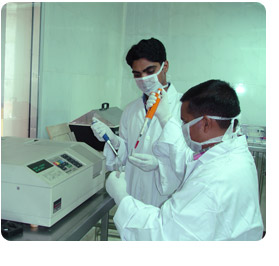
Considering requirements to control other animal diseases BIOMED added more
vaccines in the succeeding years by developing technologies for manufacture
of various vaccines in our R&D Laboratories duly recognized by the
D.S.I.R, Govt. of India, New Delhi.
For Poultry
- Ranikhet (Newcastle) Disease Vaccine, Live, Lentogenic ‘F’ Strain, I.P. (1974)
- Fowl Pox Vaccine, Live, I.P. (1974)
- Ranikhet (Newcastle) Disease Vaccine Live (Mesogenic strain) I.P. (1974)
- Marek’s Disease Vaccine, Live I.P. (1981) (Discontinued)
- Avian Infectious Bronchitis Vaccine, Live, I.P. (1984)
- Ranikhet (Newcastle) Disease Vaccine, Live, Lentogenic ‘Lasota’ Strain, I.P. (1991)
- Infectious Bursal Disease Vaccine, Live, I.P. (1993)
- Egg Drop Syndrome, 76 (1993) (Discontinued)
- Ranikhet (Newcastle) Disease Vaccine, Inactivated, I.P. (2006)
- Combined Ranikhet & Avian Infectious Bronchitis Vaccine, Live, I.P. (2006)
- Infectious Bursal Disease Vaccine, Inactivated, I.P. (2006)
For Dogs
- Rabies ‘HEP’ Flury strain (1981) (Discontinued)
- Canine Distemper (1981) (Discontinued)
- ‘LEP’ Flury strain (1984) (Discontinued)
- Rabies Veterinary Vaccine Inactivated (Cell Culture) (2011)
For Cattle
- Haemorrhagic Septicaemia Vaccine (1991)
- Black Quarter Vaccine (1991)
- Combined HS & Black Quarter Vaccine, Inactivated (1993)
- Rinderpest (T.C.) Vaccine (1993) (Discontinued)
For Sheep & Goats
- Enterotoxaemia Vaccine, I.P. (1981)
- Sheep Pox Vaccine, Live, I.P. (1991)
- Peste Des Petits Ruminants Vaccine, Live I.P. (2015)
- Clostridium Perfringens Vaccine, Inactivated I.P. (Type B, C & D) (2016)
Thus BIOMED provides different types of vaccines to control hitherto
unprotected livestock from preventable diseases. The farmer’s confidence
developed by leaps & bounds and this improved their economy significantly.